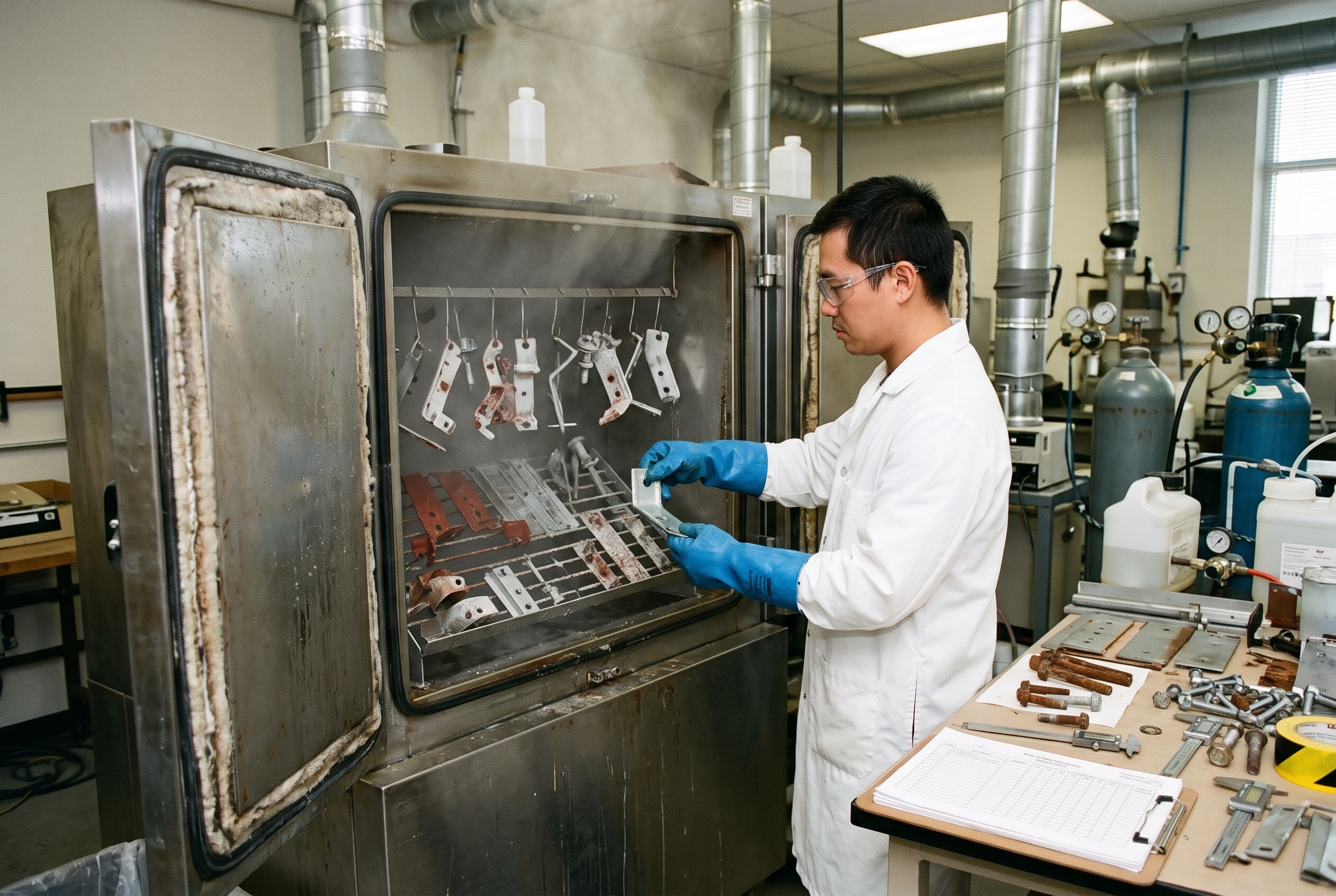
Exposed metallic assemblies operating across humid coastlines, industrial zones, and wet highway corridors face relentless chemical oxidation that gradually compromises both structural strength and visual finish. Although electroplating, powder coating, and chemical passivation are engineered to block moisture from reaching underlying steel or aluminum, microscopic pinholes and uneven coverage remain invisible to the naked eye during production. A salt spray test is a standardized accelerated corrosion laboratory evaluation that subjects coated metals, bare alloys, and hardware assemblies to a continuous, heated fog of controlled saline solution inside a sealed chamber. By condensing years of harsh atmospheric exposure into days or weeks, quality assurance teams can quickly expose weak surface finishes before defective batches enter commercial service.
Rather than waiting for outdoor weathering to reveal premature rust, manufacturers rely on controlled saline mist chambers to benchmark competing paint vendors, audit plating line consistency, and confirm that protective barrier films satisfy strict engineering specifications.
Core Chamber Variations Matched to Coating Chemistry
Analytical laboratories adjust fog chemistry and chamber temperatures to mirror specific metal substrates and protective coating architectures.
- Neutral Salt Spray Exposure: Technicians atomize a five percent sodium chloride solution maintained at neutral acidity and steady elevated temperature. This widely specified baseline method effectively evaluates zinc plated fasteners, hot dip galvanized steel, anodized aluminum panels, and industrial organic paint layers for white rust, red rust, and coating blistering.
- Acetic Acid Salt Spray: Adding glacial acetic acid lowers the fog acidity to create a more aggressive corrosive medium. Surface engineers frequently choose this accelerated variation to expose hidden porosity inside decorative copper, nickel, and chromium electroplated finishes as well as heavy architectural aluminum coatings.
- Copper Accelerated Acetic Acid Testing: Introducing trace copper chloride into an acidified saline mist at elevated chamber temperatures generates rapid electrochemical attack. This intensive method is tailored for verifying multilayer decorative chrome plating and heavy duty trim hardware engineered for extreme exterior exposure.
- Scribed Creepage and Adhesion Evaluation: Before entering the chamber, technicians often cut a calibrated scratch through painted panels straight down to the bare metal substrate. Measuring how far rust undermines the paint film outward from the scribe line reveals whether chemical pretreatment and primer bonding can arrest localized corrosion after real world stone chips or surface scratches.
Industrial Sectors Dependent on Accelerated Corrosion Screening
Verifying barrier durability safeguards mechanical longevity and aesthetic integrity across numerous exterior engineering applications.
- Automotive Fasteners and Underbody Hardware: Brake calipers, suspension bolts, exhaust brackets, and wheel hubs endure constant exposure to road water, coastal humidity, and abrasive grit. Routine chamber validation confirms that zinc nickel plating and electrocoat primers prevent seized threads and structural rust.
- Marine Equipment and Coastal Infrastructure: Dockside cranes, ship deck fittings, and offshore structural clamps operate directly inside salt laden marine air where unprotected carbon steel degrades rapidly. Accelerated testing validates duplex paint systems and stainless alloy passivity prior to maritime installation.
- Solar Mounting Racks and Outdoor Telecom Cabinets: Photovoltaic aluminum framing, steel utility enclosures, and roadside electrical switchgear remain exposed to tropical monsoon rain and coastal wind for decades. Qualified coating screening ensures continuous structural integrity and prevents moisture ingress into sensitive outdoor electronics.
- Architectural Hardware and Industrial Metal Finishing: Door hinges, curtain wall anchors, and commercial powder coating job shops perform batch level chamber audits to verify pretreatment bath stability and uphold long term warranty commitments.
Validating protective surface treatments through reproducible corrosion data eliminates costly field rust claims and proves manufacturing discipline across international supply chains. By scheduling an accredited Salt spray test through an Alstesting Laboratory Testing service in Malaysia, metal finishers and industrial hardware producers secure certified third party performance verification tailored for demanding Southeast Asian and global export markets.
Frequently Asked Questions (FAQ)
What is the difference between white rust and red rust during corrosion inspection?
White rust appears as a chalky white or grayish powder formed when protective zinc plating oxidizes sacrificially to shield the underlying steel. Red rust is iron oxide emerging directly from the base steel substrate, indicating that the protective zinc or paint barrier has been breached and structural metal corrosion has begun.
Can hours spent in a salt spray chamber be directly converted into years of outdoor service?
No exact universal mathematical formula translates chamber hours directly into outdoor calendar years because natural environments fluctuate daily across sunlight, dry periods, rainfall, and airborne industrial pollutants. Instead, accelerated saline fog testing serves as a highly repeatable comparative benchmark to confirm coating uniformity and verify that production parts match historical pass standards.
Why are test panels tilted at a specific angle inside the corrosion chamber?
Standards require flat specimens to be supported at a precise incline, typically fifteen to thirty degrees from vertical, so heavy saline droplets cannot pool stagnantly on horizontal faces or drip directly from upper samples onto lower parts. This angled mounting guarantees uniform fog deposition and repeatable surface runoff across every tested piece.