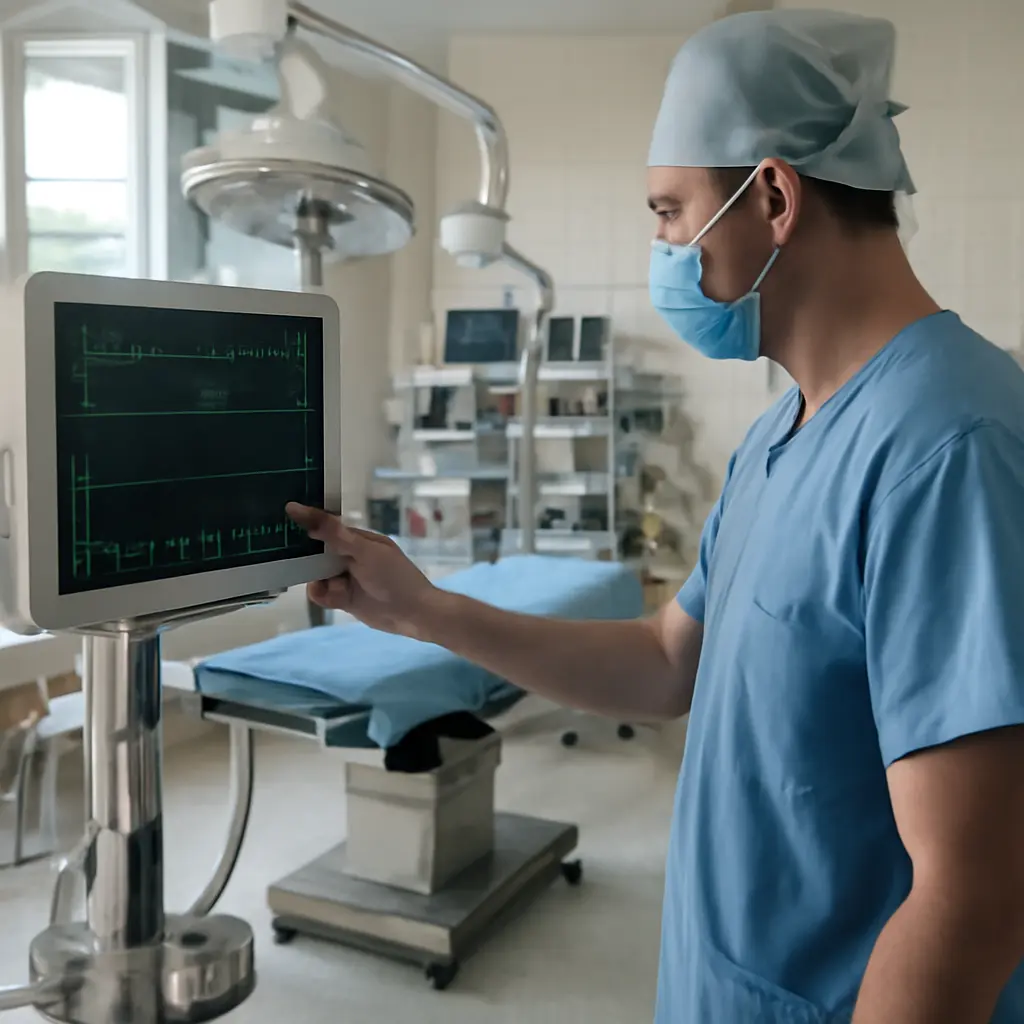
During open-heart surgery, artificial intelligence (AI) can help teams notice patterns that may signal danger, but it does not independently diagnose patients or guarantee that lives will be saved. In cardiac operating rooms, the most established AI-adjacent tools include predictive monitors, decision-support systems, and computer vision research that interprets live clinical data. Their value depends on whether alerts are timely, accurate, and actionable—and whether clinicians can distinguish useful warnings from noise. Evidence from cardiac surgery shows that AI can predict certain complications, while broader studies of clinical decision support also highlight risks such as false alarms, workflow disruption, and uneven performance across patient groups.
How AI alerts support open-heart surgery: prediction, monitoring, and response
An AI alert is a notification generated when a computational system identifies a pattern associated with a clinical condition or adverse event. In surgery, these systems may analyze vital signs, laboratory results, electronic health records, or signals from anesthesia and heart-lung bypass equipment. The alert is intended to support a clinician’s judgment—not replace it. The U.S. Food and Drug Administration (FDA) describes software functions that analyze medical data and provide recommendations as a broad category of clinical decision-support technology; whether a particular product is regulated as a medical device depends on its intended use and capabilities.
The need for dependable monitoring is substantial. The Society of Thoracic Surgeons Adult Cardiac Surgery Database has tracked outcomes for millions of cardiac procedures, reflecting the scale and complexity of care in this field. Open-heart operations can involve rapid changes in blood pressure, oxygen delivery, temperature, rhythm, and bleeding. A warning that arrives early enough to prompt a meaningful check may help clinicians respond sooner, but a model’s prediction alone does not establish that an intervention will improve outcomes.
Predictive alerts: identifying risk before deterioration
Predictive alerts estimate the likelihood of a future event from data available now. In cardiac surgery, relevant targets may include acute kidney injury, low cardiac output, prolonged ventilation, or postoperative complications. A 2023 study in Nature Medicine evaluated an AI model designed to predict acute kidney injury after cardiac surgery using perioperative data. The study reported strong predictive performance in its evaluated settings, but—as with other retrospective and validation studies—prediction does not by itself prove that acting on the alert changes patient outcomes. Clinical impact requires prospective testing and careful measurement of benefits and harms.
A useful prediction must also be interpretable enough to guide a response. A team needs to know what risk is being flagged, over what time horizon, and which data contributed. Otherwise, clinicians may receive a high-risk score without a clear next step. For this reason, model evaluation should include calibration, sensitivity, false-positive rates, and performance across hospitals and patient groups—not accuracy alone.
Real-time monitoring alerts: interpreting changing signals
Real-time monitoring alerts draw on continuous or frequently updated signals, including electrocardiograms, arterial pressure, oxygen saturation, and, during cardiopulmonary bypass, machine and perfusion measurements. AI methods can help identify combinations or trends that are difficult to see in a stream of separate readings. Yet many alerts in operating rooms are generated by established threshold rules rather than machine-learning models; describing every automated alarm as AI would therefore be inaccurate.
Alarm fatigue is a central safety concern. The Joint Commission has warned that frequent, nonactionable alarms can desensitize clinicians and contribute to missed or delayed responses. A systematic review published in BMJ Open found that alarm burden and response practices vary considerably across clinical settings, making local assessment important. In an operating room, an alert must be evaluated alongside the patient’s condition, the surgical phase, and the reliability of the underlying sensor.
Computer vision: reading the operative environment
Computer vision is a branch of AI that analyzes images or video. In surgery, researchers are investigating its use for recognizing procedural phases, tracking instruments, and identifying events from operating-room video. Such systems could eventually provide context-sensitive prompts, but image-based AI remains an emerging area, and evidence from laboratory or retrospective studies should not be mistaken for proof of routine life-saving use in open-heart operating rooms.
The distinction between research potential and clinical deployment matters. Video systems must handle occlusion, changing camera angles, blood, lighting variation, and differences in surgical technique. They also raise privacy, data-governance, and cybersecurity questions. A computer-vision alert should be tested against real clinical workflows and should not distract staff from direct observation or established safety protocols.
How AI alerts move from a signal to a clinical response
An alert can only help when it connects a detected pattern to a reliable response. The pathway typically includes data capture, model analysis, notification, clinician assessment, and—if appropriate—an intervention. Each link can fail: a sensor may be inaccurate, the model may not fit the patient, the notification may be overlooked, or the suggested response may not be appropriate for the operative moment.
The alert-to-action workflow
- Data are collected from monitors, laboratory systems, the electronic health record, or bypass equipment.
- A rule or model estimates a risk or detects a pattern that meets a defined threshold.
- The system presents an alert, ideally with the reason, urgency, and relevant supporting data.
- A qualified team member checks the patient and verifies that the signal is clinically meaningful.
- The team decides whether to act, document a reason for not acting, or request further assessment.
The Agency for Healthcare Research and Quality emphasizes that clinical decision support should fit the workflow and present information when and where it can inform a decision. In a cardiac operating room, that means alerts need to be coordinated with the roles of surgeons, anesthesiologists, perfusionists, and nurses. An alert that reaches the wrong person or arrives during a critical task may add burden without improving care.
Human oversight and team communication
Human oversight means clinicians retain responsibility for interpreting an alert and deciding what to do. The World Health Organization’s guidance on AI for health calls for human autonomy, transparency, and accountability. In practice, a safe system should make it clear that an alert is advisory, identify its limitations, and allow staff to question or override it.
Team communication is especially important when a warning concerns a shared process such as bypass management or hemodynamic instability. A structured verbal acknowledgment—who received the alert, what was checked, and what action followed—can reduce ambiguity. Hospitals should also review missed alerts and unnecessary alerts as part of quality improvement, rather than treating the software’s output as self-validating.
False alarms, bias, and model drift
A false positive occurs when a system warns of a problem that is not present; a false negative occurs when it fails to warn of a problem that develops. Both matter in surgery. Excessive false positives can increase alarm fatigue, while false negatives can create misplaced confidence. Model bias can arise when development data do not adequately represent the patients or institutions where the system is used.
Performance can also change over time as devices, documentation practices, patient populations, and clinical protocols evolve—a problem known as model drift. The FDA’s action plan for AI and machine-learning-enabled medical devices describes the need for lifecycle oversight, including monitoring performance after deployment. Hospitals should establish ownership for periodic review, version control, incident reporting, and reassessment when the model or workflow changes.
Evidence, benefits, and limits of AI in cardiac operating rooms
AI’s strongest near-term promise is decision support: helping clinicians synthesize complex data, identify patterns, and prioritize attention. But a model’s technical performance is not the same as proof of improved survival. Studies need to distinguish predictive accuracy from clinical utility and evaluate whether alerts change treatment appropriately, reduce complications, or improve patient-centered outcomes.
What clinical studies can establish
A retrospective study can show that a model identifies risk in historical records. External validation can test whether it performs in a different population or hospital. A prospective clinical study can assess how it behaves in real time, while an impact study can examine whether use of the alert improves outcomes compared with usual care. These are distinct stages of evidence, and a promising result at one stage does not automatically establish benefit at the next.
For example, the cardiac-surgery acute-kidney-injury prediction study reported in Nature Medicine supports the feasibility of using perioperative data for risk prediction. It does not justify saying that AI alerts have been shown generally to save lives during open-heart operations. Claims about lives saved require outcome evidence that directly links alert use and clinical response to a reduction in mortality.
Potential benefits—and what they depend on
Potential benefits include earlier recognition of deterioration, more consistent risk assessment, and better prioritization of limited clinical attention. These benefits depend on data quality, appropriate thresholds, reliable integration with monitors and records, clinician trust, and a response pathway that is feasible in the operating room. Poorly designed systems can instead create interruptions, duplicate existing alarms, or encourage automation bias—the tendency to accept a computer’s recommendation without sufficient independent checking.
The National Academy of Medicine has emphasized that health-system transformation requires attention to safety, equity, and learning—not technology alone. An AI tool should therefore be judged against a clearly defined clinical problem and compared with current practice. Useful measures can include alert frequency, positive predictive value, response time, complications, mortality, workflow burden, and performance by demographic and clinical subgroup.
A practical scorecard for hospitals
- Clinical validity: Does the system work in the intended cardiac-surgery population and setting?
- Actionability: Does an alert correspond to a response the team can reasonably take?
- Safety: Are false alerts, missed events, and unintended workflow effects measured?
- Equity: Is performance checked across relevant patient groups and hospitals?
- Governance: Are responsibilities, update procedures, privacy protections, and incident reviews defined?
- Impact: Is there evidence that using the system improves outcomes or care processes compared with usual practice?
A simple chart for a hospital quality report could compare alert volume, confirmed events, response time, and outcomes before and after deployment. Such a chart should include uncertainty and patient-group breakdowns where appropriate; a lower complication rate alone cannot establish that AI caused the change if other practices changed at the same time.
Conclusion: AI alerts are support systems, not substitutes for surgical judgment
AI alerts in open-heart surgery include predictive models, real-time monitoring tools, and emerging computer-vision applications. Research shows that models can identify risk patterns, including risks associated with cardiac-surgery complications, but predictive performance is not proof that an alert saves a life. The value of an alert depends on clinical validation, clear communication, human oversight, fair performance, and a measured response pathway.
Hospitals considering these tools should ask for evidence from the intended setting, monitor false alarms and outcomes after implementation, and involve the entire operating-room team in design and review. Further reading from the FDA, the World Health Organization, the Agency for Healthcare Research and Quality, and the Society of Thoracic Surgeons can help clinicians and patients understand how decision-support systems are evaluated and governed.
Sources: U.S. Food and Drug Administration, Clinical Decision Support Software, https://www.fda.gov/regulatory-information/search-fda-guidance-documents/clinical-decision-support-software; Society of Thoracic Surgeons, Adult Cardiac Surgery Database, https://www.sts.org/registries-research-center/sts-national-database/adult-cardiac-surgery-database; Nature Medicine, Artificial intelligence for prediction of acute kidney injury after cardiac surgery, https://www.nature.com/nm/; The Joint Commission, Medical device alarm safety in hospitals, https://www.jointcommission.org/resources/patient-safety-topics/medical-device-alarm-safety/; BMJ Open, Systematic review of alarm fatigue and clinical alarm management, https://bmjopen.bmj.com/; Agency for Healthcare Research and Quality, Clinical Decision Support, https://www.ahrq.gov/cpi/about/otherwebsites/clinical-decision-support/index.html; World Health Organization, Ethics and Governance of Artificial Intelligence for Health, https://www.who.int/publications/i/item/9789240029200; U.S. Food and Drug Administration, Artificial Intelligence/Machine Learning (AI/ML)-Based Software as a Medical Device (SaMD) Action Plan, https://www.fda.gov/medical-devices/software-medical-device-samd/artificial-intelligence-and-machine-learning-software-medical-device; National Academy of Medicine, Artificial Intelligence in Health Care: The Hope, the Hype, the Promise, the Peril, https://nam.edu/artificial-intelligence-in-health-care-the-hope-the-hype-the-promise-the-peril/